



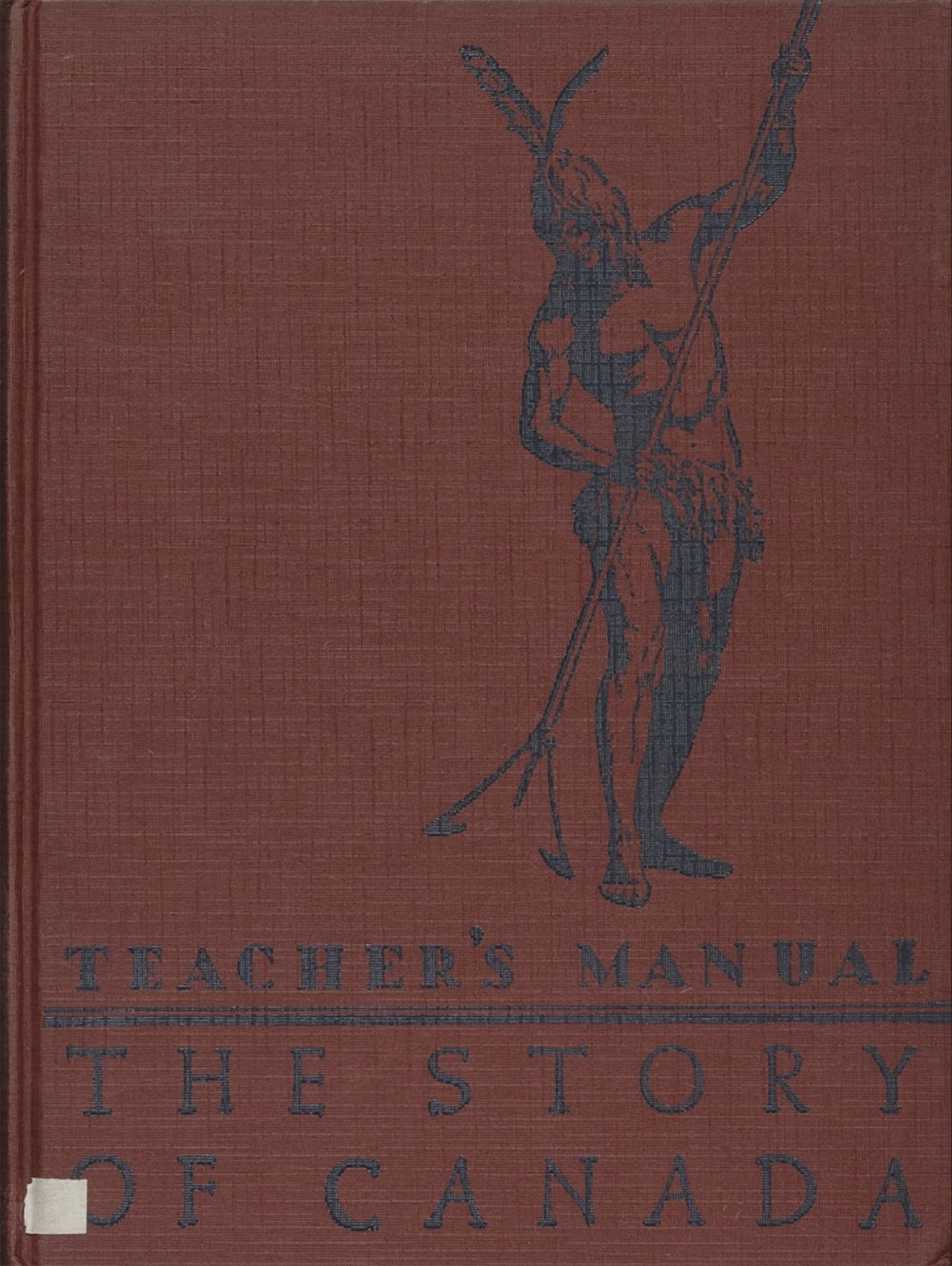
Brown, Harman and Jeanneret write in the aftermath of World War II, a time that seems all too remote. In fact, it is, unfortunately, more akin to ongoing developments than we might wish it were. We are not just thinking of the use of the word ‘fascist’ to represent certain current ideologies and state-sponsored actions. It’s worth also thinking about one of today’s most pervasive problems, with enormous consequences for individuals and societies: technological developments and double-edge innovations (e.g., the social media) have led to what is often called a post-truth world. “What is the truth?” is a question asked perhaps more often today than ever despite the unprecedented dissemination and democratization of knowledge. This question was very much of the mind of these Canadian authors, who, five short years after World War II were grappling with similar challenges. In their preface, they note that “The school cannot avoid teaching attitudes and points of view even if it wished to do so. Consciously or unconsciously, they will permeate the classroom.” (p. ix)
This is not a neutral statement; for our authors, it is avowedly an expression of deep concern in the wake of the propaganda wielded on an extraordinary scale and with devastating intensity by Nazi Germany and the Soviet Union, as they point out explicitly. If the present is sometimes hard to fully comprehend (p. x), grasping and conveying the past can be all the more challenging. And perhaps Canada is especially prone to misrepresentations of the past (p. xi) given, among other things, its over-emphasis on the contributions of the white colonizers etc. All this reflection about how best to teach history without being unduly biased amounts ultimately to an important exercise in rethinking the very foundations of education, and of contemplating its future. The teacher’s duty to have as deep and balanced a command of the history of their nation is, in the opinion of these three authors, a civic duty, demanded by the condition of living in a democracy worth the name. We can call this ‘past future’ in the sense that we are dealing here with pedagogical minds that were trying in the past (1950) to prepare the terrain for a future education free of the dangers of political propaganda and of other insidious perils. Is this radically different from our times? Well, to answer this question, it may be enough to just think about the controversies raging today over the use of textbooks in Canada’s neighbor – the United States – where teaching about slavery and about contemporary social inequality hinges sometimes on dictates coming from governors’ mansions more than from reputable historians, and where bans on books in public libraries multiply every week.
How should the truth be captured, protected and conveyed, then, in schools in a ‘post-truth’ society? It sure feels like Brown, Harman and Jeanneret are suddenly becoming our contemporaries, as they are envisaging what the future of education might or should be like. One of the reasons history is such a crucial component of education is that, to state the obvious, it helps us to better understand ourselves: “Can history teach us to understand the present? To help the child understand, as far as we can, the world in which he lives, and to train him to take his place in it to the best of his ability along with his fellows, are among the primary aims of education in a democracy.” (P. xii-xiii)
A Story Workbook in Canadian History
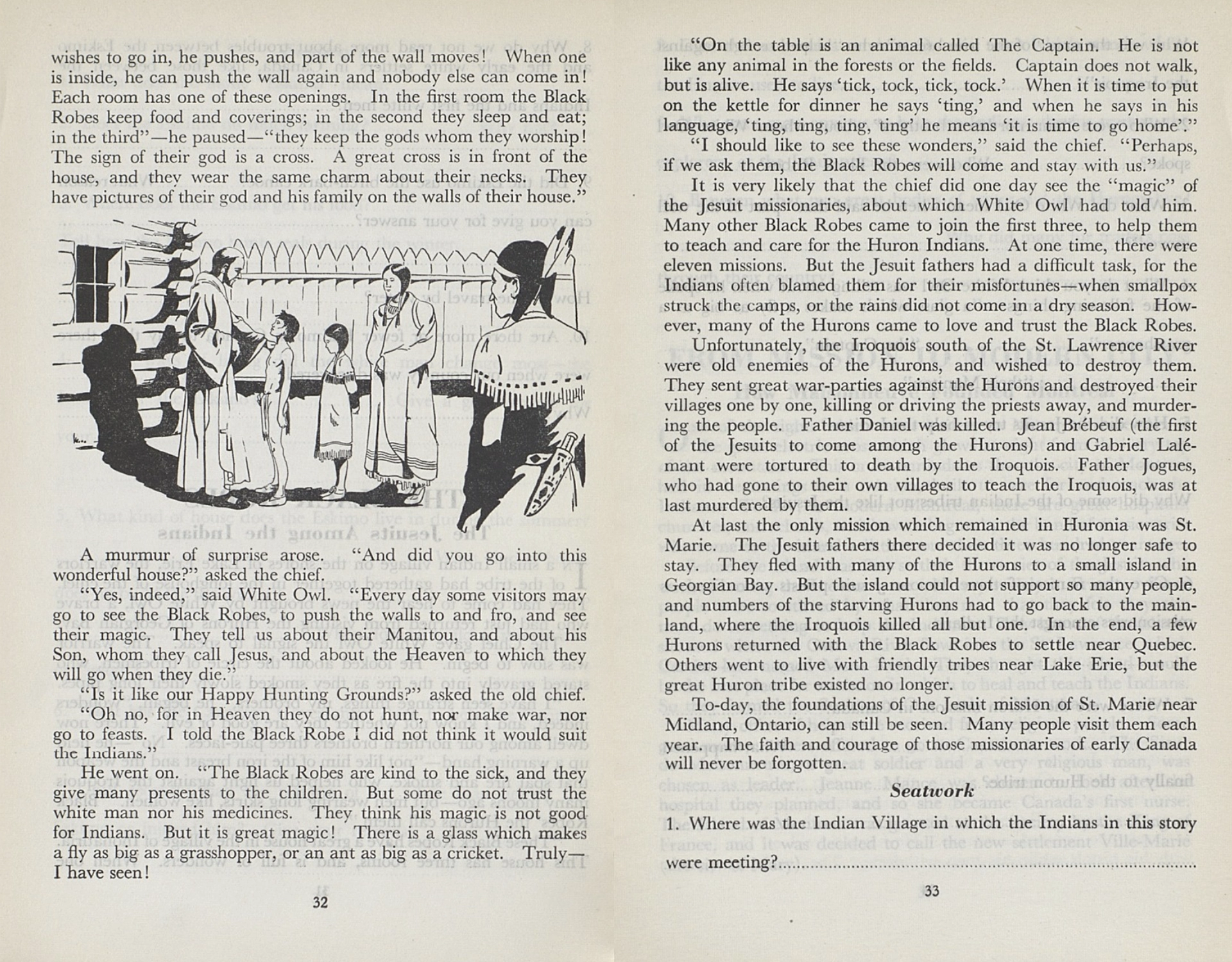
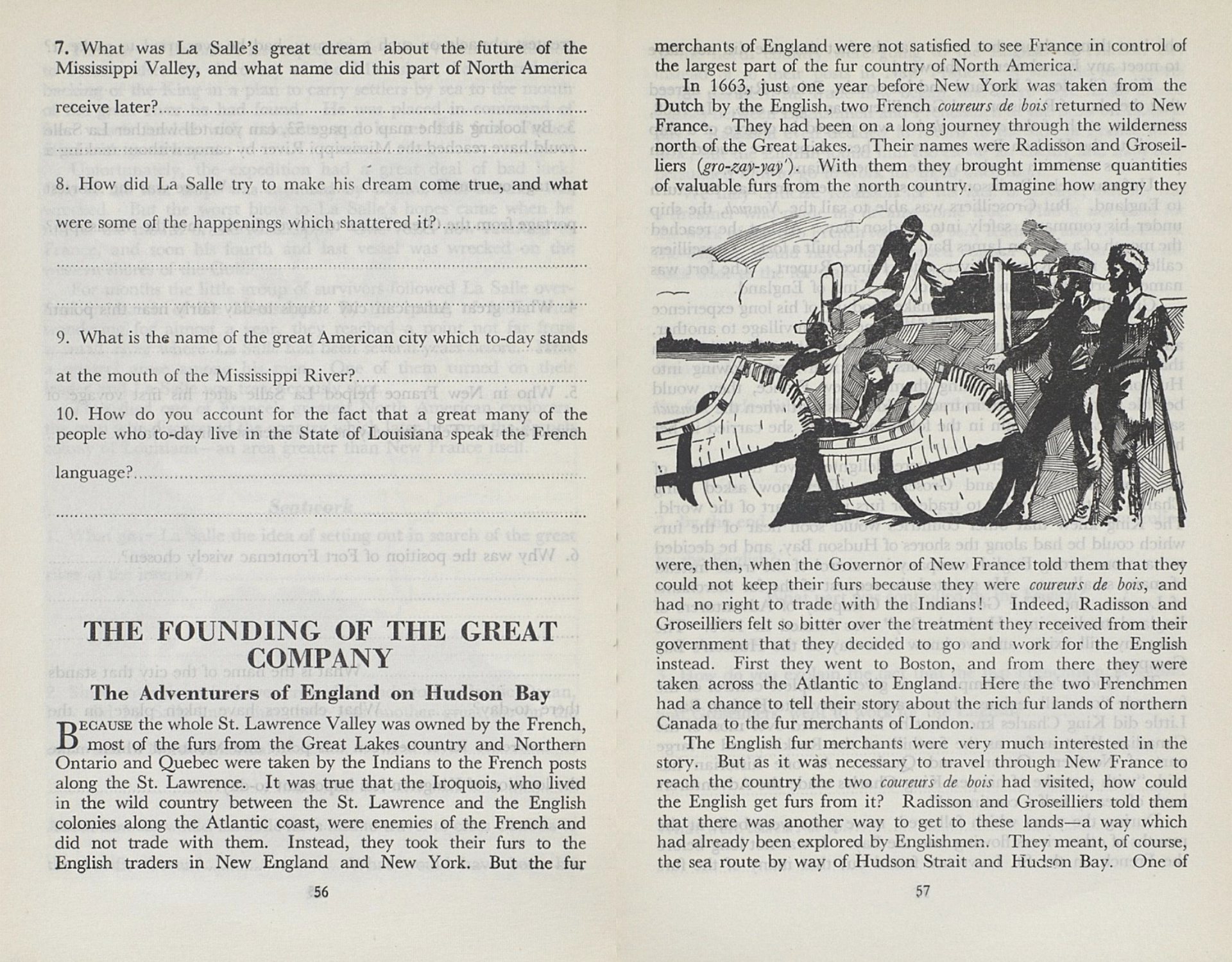
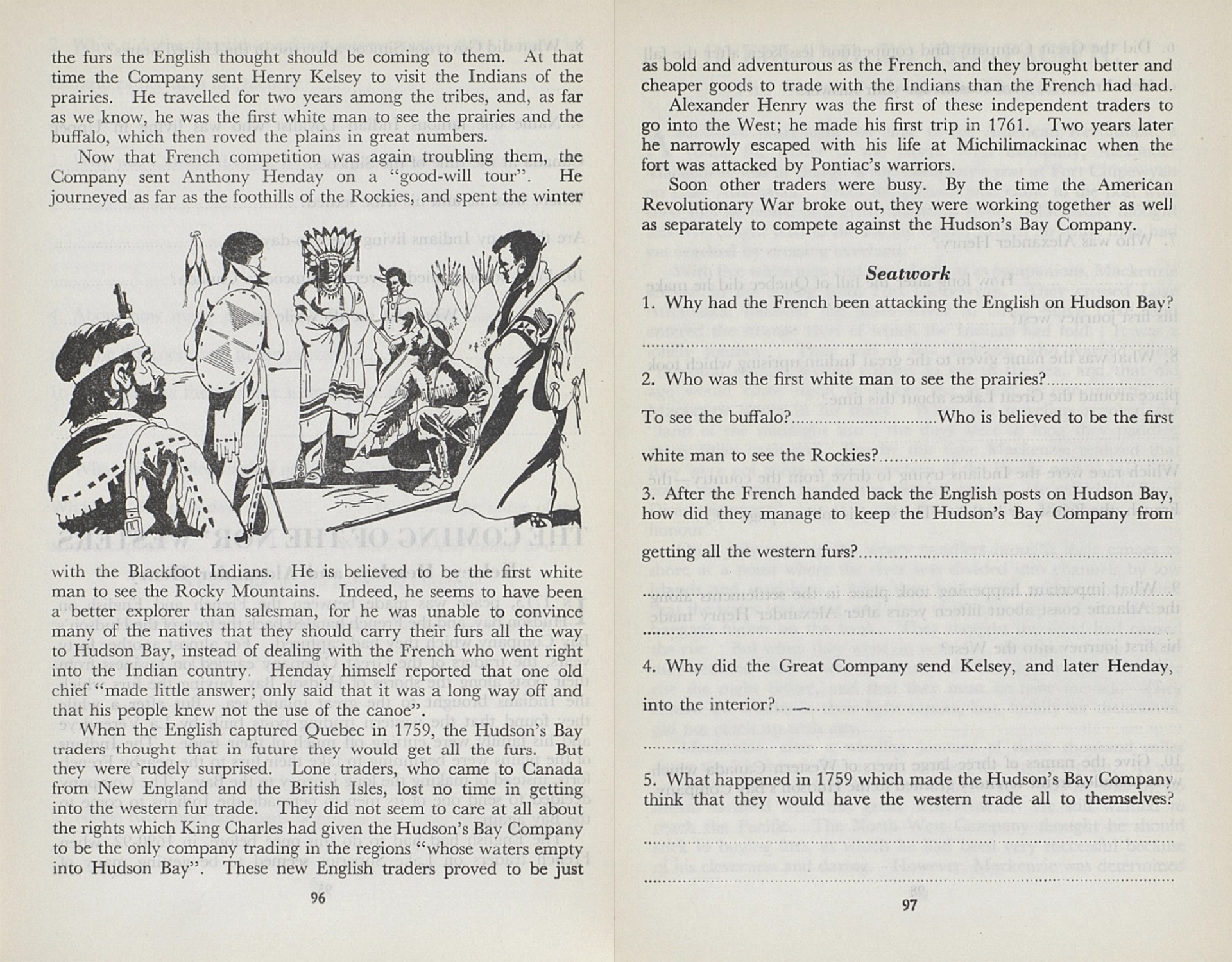
Two of these authors, Eleanor Harman and Marsh Jeanneret, also cowrote another history of Canada – incidentally, published in the same year, 1950 – staying true to their pedagogical ideals, while adopting a different approach in the presentation of their material. This is a collection of stories, each accompanied by a set of questions meant to allow the students to put their interpretive and analytical skills to work. Quite clearly, they are concerned with providing sufficient (and sufficiently reliable) factual elements that will stimulate the students’ imagination, but will also evoke important past episodes in a way that is as free of bias as reasonably possible. This is especially difficult when presenting potentially controversial aspects such as the interaction of the native populations with the French and the British. How do you give proper emphasis to the cultural wealth of the former, without describing the latter in schematic and maybe over-critical way (and the other way around)? This delicate balance is a departure from earlier depictions of the European colonizers as selfless benefactors, and of Catholicism as a necessary civilizing instrument in the lives of indigenous people, and is a way of looking to the future of the (here: Canadian) education with equal measures of tact and innovation.
Our Democracy, A Textbook for Grades VII-VIII
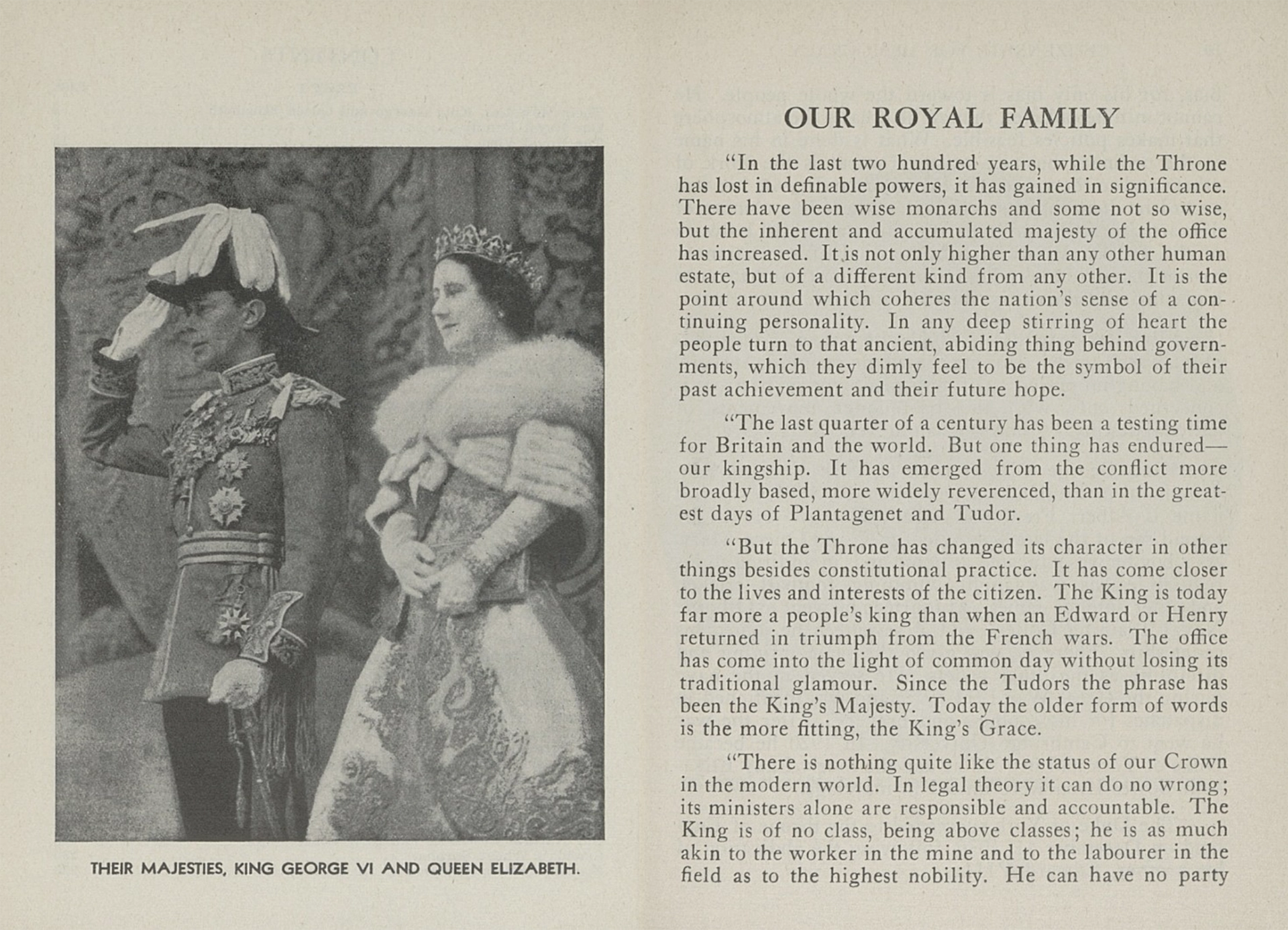
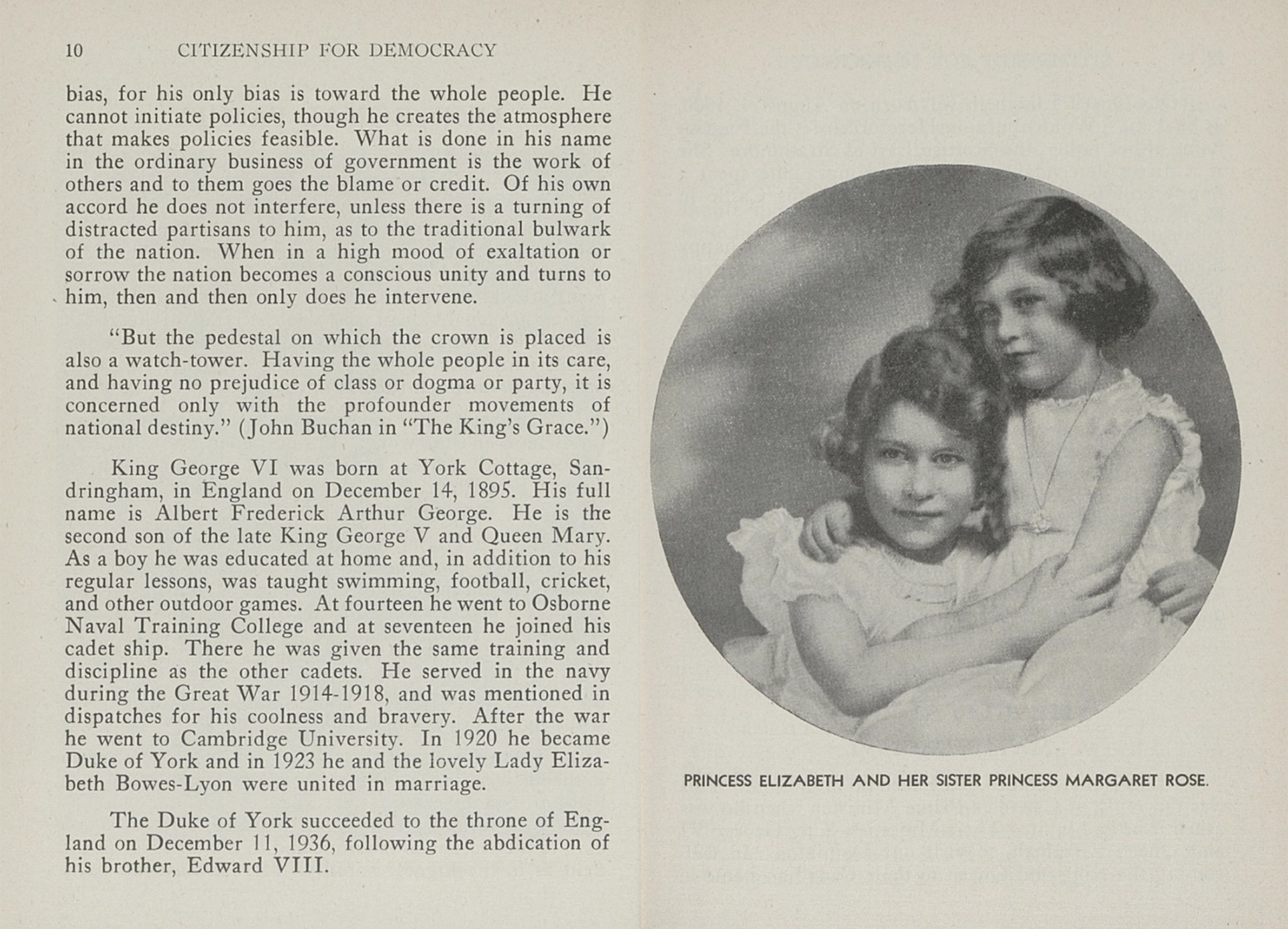
To better understand the shift they are proposing, it might be useful to take a look at an earlier and more conservative way of revealing the heart of Canadian democracy. Granted, the book written by Scarrow, Lewis and Griffin is not a history book, as it attempts to outline current social and political institutions, but history clearly looms large here too. What is striking, however, is the near absence of references to indigenous populations and to their rights and traditions. It’s unclear exactly when this survey of Canadian democracy was published, but judging by the contents themselves and by several photographs of the British royal family, it may have been published around the beginning of World War II. A note that seems to be quoted from the Times, entitled “The Teacher’s Job”, and placed early in the book, sheds some light on the mission of this textbook: “Upon the teacher as guide, counsellor, and instructor of the young, devolves the gravest responsibility in this hour of Britain’s crisis. It has always been our proudest tradition that the chief aim of education is the training of character. Now, if ever, is the time to vindicate that tradition; for the structure of peace can be erected only on the foundation of character. If we allow the children in our care to grow up myopic in vision, intellectually dishonest, and morally maculate, we betray our trust.” One can object perhaps, even (especially?) in times of crisis, that Canadian democracy is presented as little more than an extension of British institutions. How do you avoid myopia after all? Perhaps Harman and Jeanneret (see above) may have something to say about this, and about the future of education…
A West African Mathematics, Book One; Teacher’s Book
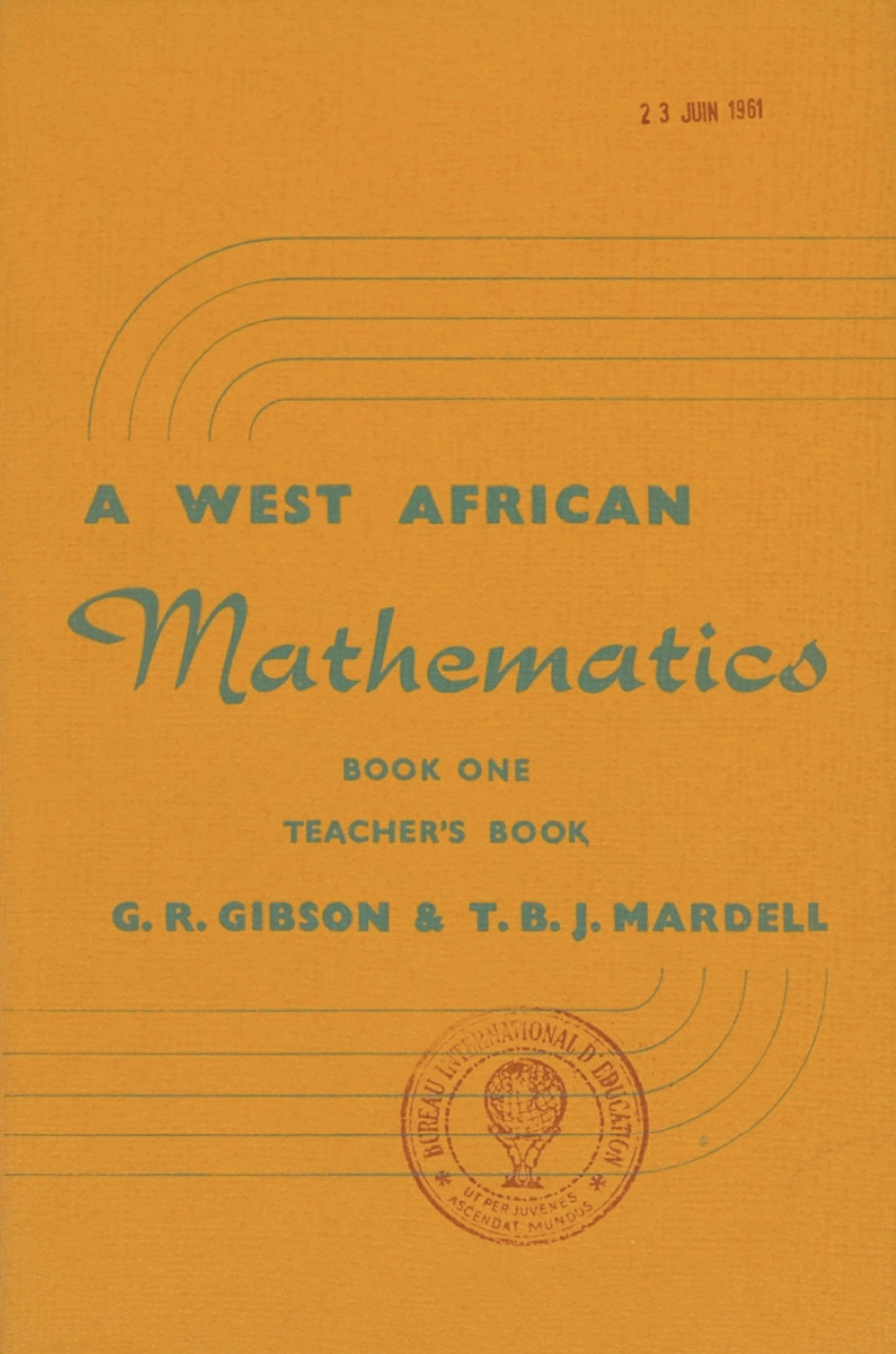
Staying in the Commonwealth and in the sphere of English as language of instruction, we suggest adding another panel to this polyptych. The future of education, as contemplated at various points in the past and as reflected in IBE’s remarkable archives, inevitably echoes turning points in our history. One such turning point can be the eve or the aftermath of the moment when colonies gained their independence, as their future depended to a great extent on how their education would be conceived and structured. In A West African Mathematics (1959), Gibson and Mardell, both of whom had a chance to teach in Ghana, propose a method that is not only clearly articulated and easy to implement, but quite novel compared to many earlier and rather stodgy approaches. They make it clear from the outset that the students should be in charge (albeit in an environment carefully prepared by the teacher), if the course is to be successful. The teacher’s attitude is vital to encouraging participation: “A good teacher is interested in children as persons, and is able to treat them sympathetically and tolerantly and with a reasonable sense of humour. The more a teacher knows each and every individual that he teaches, the more he is able to make the right appeal. Interest, sympathy and tolerance do not imply a lack of firmness. Children like a sense of security, and it is hard for them to feel any such sense with a teacher who is unpleasant or unfriendly or who is friendly but is erratic and lacks firmness.” (pp. 8-9) This carefully contoured portrait of what the authors think makes a good teacher may seem out of place in a book about how best to teach mathematics to young students, but is arguably indispensable; without these assumptions, the more concrete aspects of this method would be inoperable. It is a shift that gets to the basics in order to achieve success in a particular subject matter.
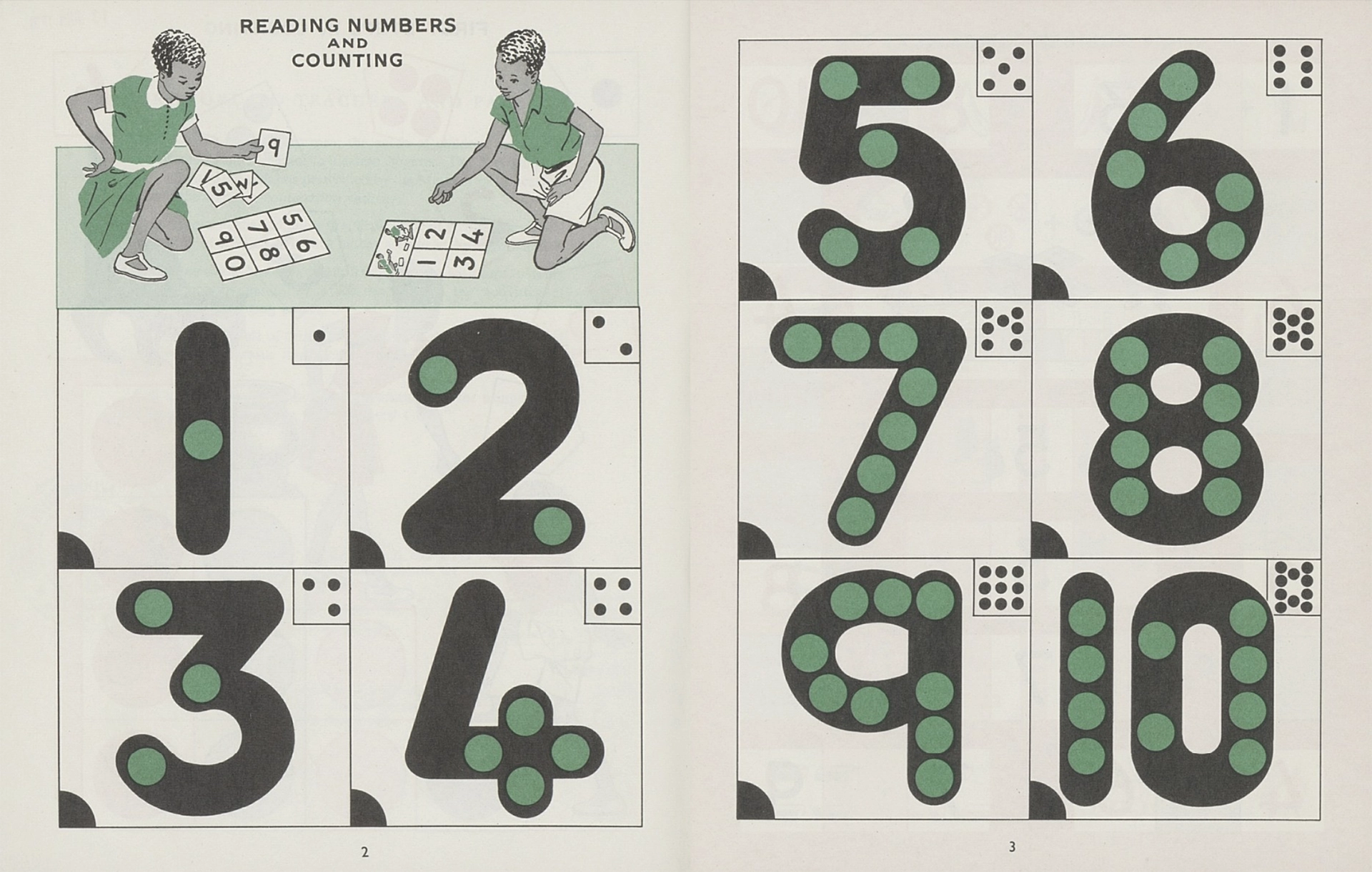
Longmans New Activity Arithmetic for Eastern Nigeria. First Infants’ Number Book
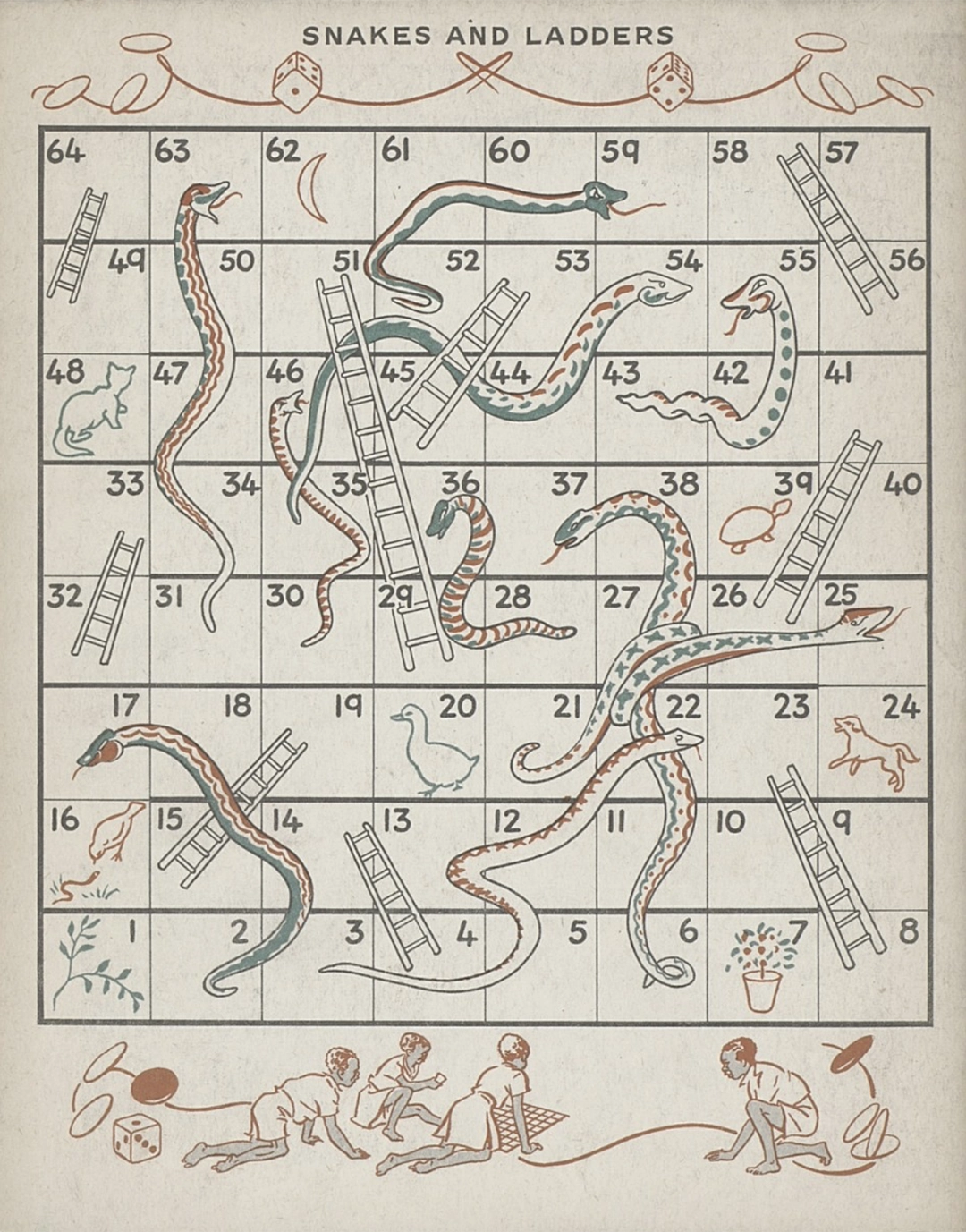
Examples can be easily added here. Perhaps in the same general vein of keeping the students’ interest alert and getting them consistently involved in class activities, one should mention the systematic and quite enticing use of images in math textbooks, especially in elementary education, of course. Longmans New Activity Arithmetic for Eastern Nigeria (1960) is one such example and points to a fresh approach to the teaching of mathematics that appeals to the students’ imagination by seamlessly combining play and education, and leaves in the dust more repetitive and crushingly dull methods.
The future of education is central to much theoretical discussion and to experimental practice in today’s pedagogy and teaching. In a way, though, we are engaging in a type of reflection that also occurred at many points in the past, when forward thinking educators were trying to suggest new goals and new methods for improving education, and thus for improving society at large. Quite a few of the problems that confronted them (for instance, grasping and conveying facts / the truth in eminently disorienting times) are still here with us, although we obviously need to find solutions that respond to current challenges (for example, the development of technologies that can be manipulated to undermine people’s sense of confidence that they can establish and secure facts / the truth). Rethinking the educators’ attitudes, the students’ expectations and the most fruitful sort of interplay between them is also something that fuels pedagogical innovation today, as it did in the past. Many more facets can be added to this topic, no doubt. We trust that others will be able to consider related aspects that are put forth and discussed in IBE’s unique collection. Perhaps we will have learned quite a bit, if we care to listen to past reformers and innovators.
Works cited
Scarrow, C.A., Lewis, W., Griffin, G.N. Our Democracy, A Textbook for Grades VII-VIII. School Aids and Textbook Publishing Co. Ltd. Regina and Toronto.
Brown, G.W., Harman, E., Jeanneret, M. 1950. The Story of Canada, Teacher’s Manual. The Copp Clark Co. Ltd., Toronto.
Harman, E., Jeanneret, M. 1950. A Story Workbook in Canadian History. The Copp Clark Co. Ltd., Toronto.
Gibson, G.R., Mardell, T.B.J. 1959. A West African Mathematics, Book One; Teacher’s Book. University of London Press, London.
Longmans New Activity Arithmetic for Eastern Nigeria. First Infants’ Number Book. 1960. Longmans, Green & Co. Ltd. London.